
B, B1 and BE driving licence categories
Vehicles are divided into different driving categories, so when choosing which category to obtain it's important to know which vehicles you want to drive. Category B, which covers passenger cars, is the most popular. B1 and BE also involve passenger cars but differ from B in driver requirements, vehicle capability or trailer weight. With these categories you may drive vehicles with automatic or manual transmission. Let's look at B, B1 and BE in detail.
How do B, B1 and BE categories differ?
Category B1
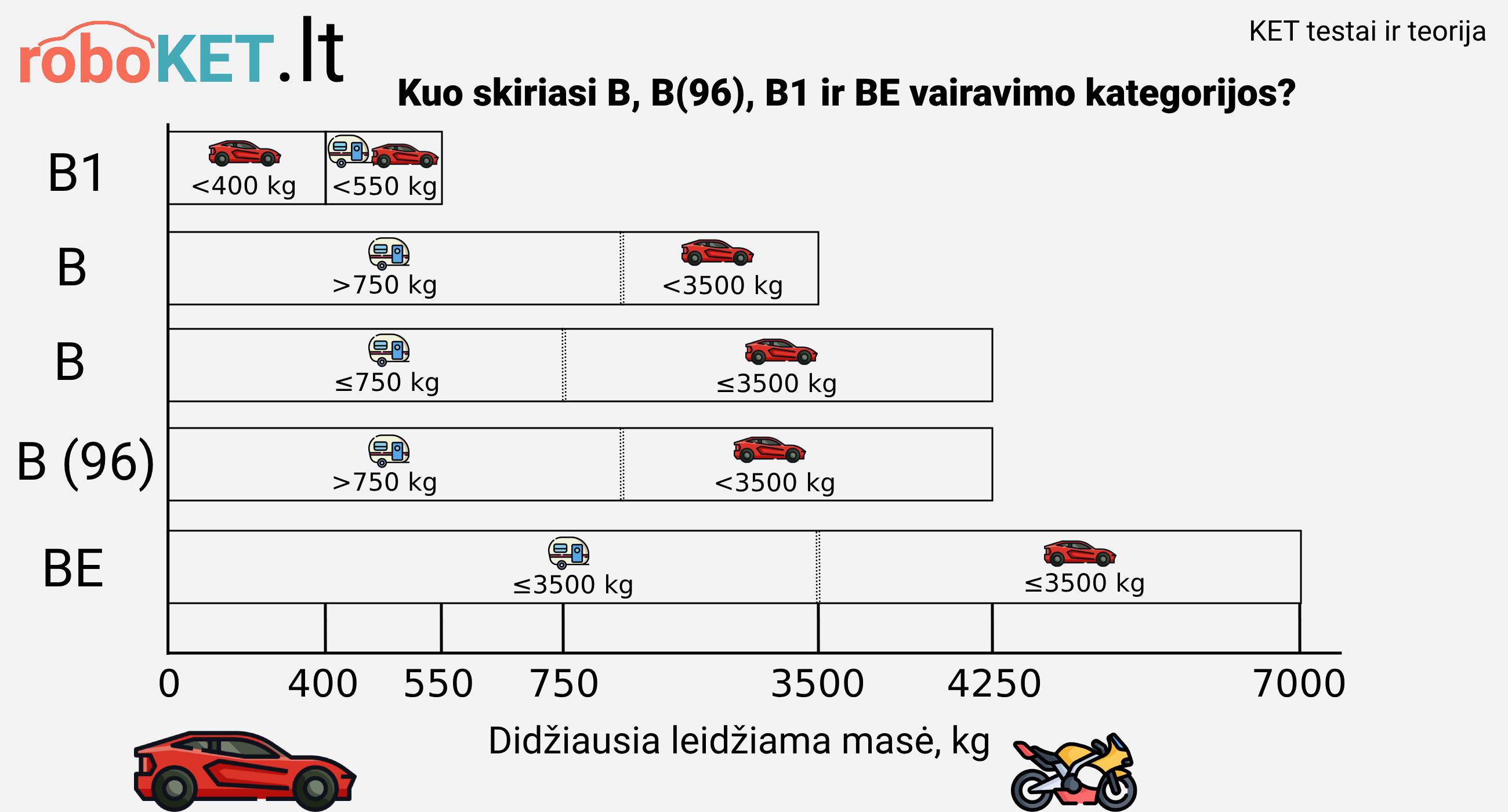
Under the Road Traffic Safety Act, category B1 covers four-wheeled motor vehicles whose maximum design speed exceeds 45 km/h and/or whose engine displacement is greater than 50 cm³. Their unladen mass may not exceed 400 kg — or 550 kg for goods vehicles (excluding battery weight for electric vehicles) — and maximum net power may not exceed 15 kW.
In plain terms: B1 covers three- or four-wheeled cars with a design speed above 45 km/h and/or engine over 50 cm³, up to 400 kg unladen (550 kg for cargo versions, batteries excluded).
The minimum age for B1 is 16 years.
The practical exam procedure at Regitra depends on the vehicle type: with a bodied B1 vehicle, the exam route and flow match category B; with a quadricycle, you perform all the category A elements.
B1 grows more popular every year, but suitable cars are still rare in Lithuania. B1 mini-cars such as Aixam, JDM, Ligier, Microcar and Secma with 125–500 cm³ engines are especially popular in France, where most of them are made.
A B1 licence is issued from age sixteen — but driving ordinary passenger cars with it is prohibited, as a B1 driver is not a full driver. Full legal responsibility begins at eighteen; if a sixteen-year-old causes an accident while driving a non-B1 vehicle, serious legal complications can follow. At 18, B1 holders must retake the exams to obtain category B.
Category B
Category B vehicles have a maximum permitted mass of up to 3,500 kg and carry no more than eight passengers besides the driver. They may tow a trailer of up to 750 kg — or a heavier trailer, as long as the combination stays within 3,500 kg total.
If a B-category car is combined with a trailer over 750 kg and the whole combination weighs between 3,500 kg and 4,250 kg, the driver needs the special code 96 entry on the licence, earned by passing an additional practical driving exam.
The minimum age for category B is 18 years.
Category BE
BE covers combinations of a B-category car with a trailer whose maximum permitted mass does not exceed 3,500 kg. If you need to tow a heavier trailer with a passenger car, you need a BE licence. A BE driver may operate a combination with a total permitted mass of up to 7,000 kg — i.e. car and trailer up to 3,500 kg each. The minimum age for BE is 18 years.
Category B with code 96
Category B with code 96 on the licence permits driving a B-category vehicle with a trailer whose maximum permitted mass exceeds 750 kg. Such a combination may exceed 3,500 kg, but the total may not exceed 4,250 kg.
How do you get code 96?
To obtain code 96 you must pass a practical driving exam (the "skills and behaviour" test) at Regitra. You need your own trailer for the exam — driving schools rent them out. No theory exam is required for this code.
Alternatively, the same combinations may be driven after passing the BE (CE and DE also qualify) category exam at Regitra — these categories rank above B with code 96, so a BE licence also covers code-96 combinations.
BE combination vs B with code 96 — the differences
- Getting code 96 is simpler than getting BE: code 96 needs only the practical exam, while BE requires both theory and practical exams.
- BE courses cost somewhat more than code-96 training.
- A BE licence opens far wider options for driving larger combinations.
- The practical exams for code 96 and BE are very similar — taken with a very similar or even identical combination.