
Speed limits on different roads in Lithuania
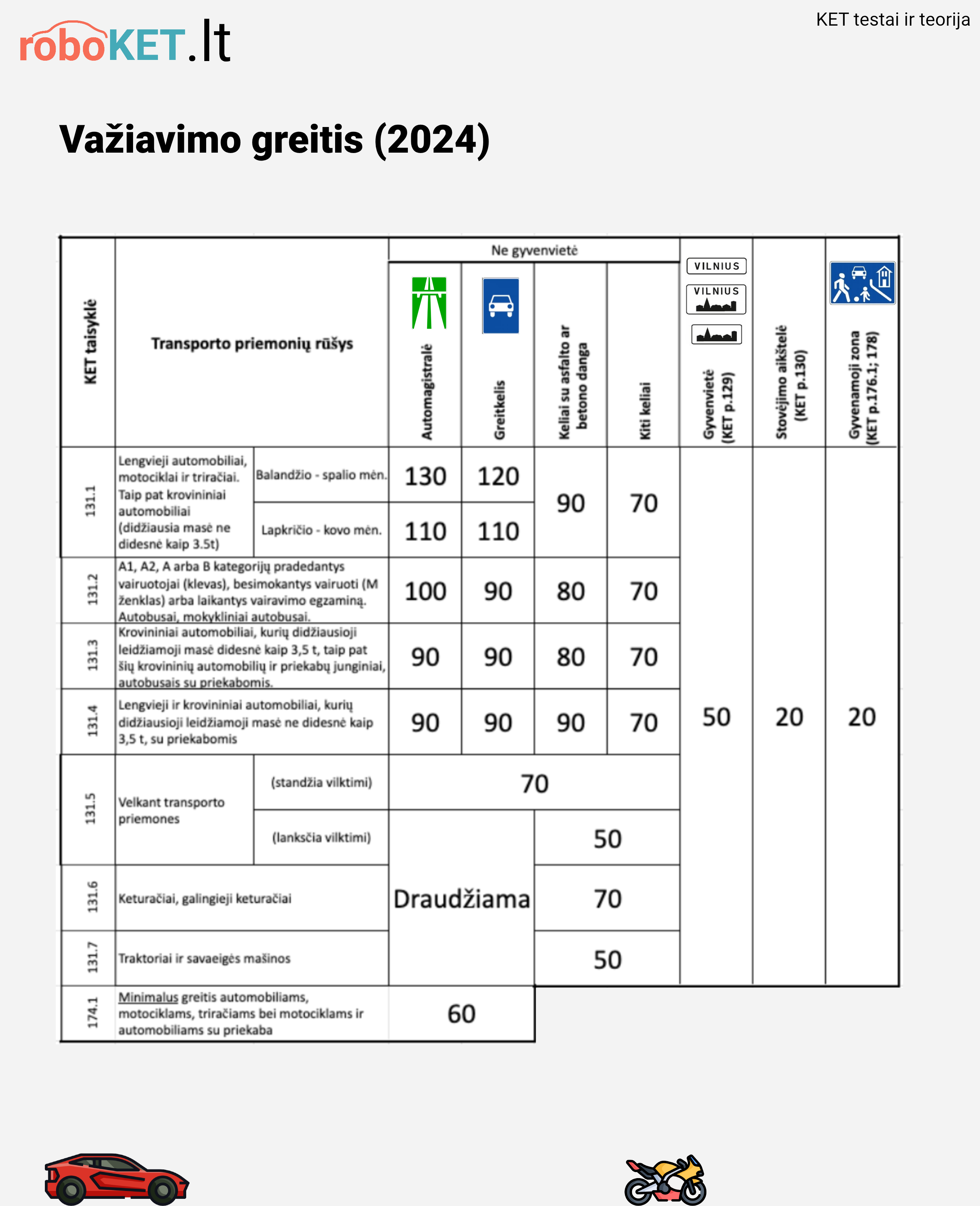
Rule 127. The driver must not exceed the permitted speed. When choosing a driving speed, the driver must take into account the driving conditions — especially the terrain, the state of the road and the vehicle, the load, weather conditions and traffic intensity — so that the vehicle can be stopped before any foreseeable obstacle. The driver must slow down, and stop if necessary, whenever circumstances require it, especially in poor visibility.
Rule 128. If an obstacle appears or road safety is threatened, the driver (if able to notice it) must slow down, stop completely if needed, or drive around the obstacle without endangering other road users.
Built-up areas and parking lots
Rule 129. In built-up areas, all vehicles may drive at no more than 50 km/h.
Rule 130. In parking areas, all vehicles may drive at no more than 20 km/h.
Outside built-up areas (Rule 131)
131.1. Cars, trucks up to 3.5 t, motorcycles and tricycles: on motorways — up to 130 km/h April–October and 110 km/h November–March; on expressways — up to 120 km/h April–October and 110 km/h November–March; on asphalt or concrete roads — up to 90 km/h; on other roads — up to 70 km/h.
131.2. A1, A2, A or B category vehicles driven by novice drivers, learner drivers or people taking the practical exam, and buses (including school buses): motorways — up to 100 km/h; expressways — up to 90 km/h; asphalt/concrete roads — up to 80 km/h; other roads — up to 70 km/h.
131.3. Trucks over 3.5 t, truck-and-trailer combinations, and buses with trailers: motorways and expressways — up to 90 km/h; asphalt/concrete roads — up to 80 km/h; other roads — up to 70 km/h.
131.4. Cars and trucks up to 3.5 t with trailers: motorways, expressways and asphalt/concrete roads — up to 90 km/h; other roads — up to 70 km/h.
131.5. Towing with a rigid tow bar — up to 70 km/h; with a flexible tow rope — up to 50 km/h.
131.6. Quadricycles and heavy quadricycles — up to 70 km/h.
131.7. Tractors and self-propelled machinery — up to 50 km/h.
Signs, increases and prohibitions
Rule 132. Where the permitted speed is increased or reduced by road signs, the driver must follow the signs — but the chosen speed may never exceed the maximum set in Rule 131 for that vehicle or combination.
Rule 133. On road sections where conditions allow safe faster driving, the road owner may raise the limit by installing the corresponding signs.
Rule 135. The driver is prohibited from: exceeding the manufacturer's maximum design speed regardless of a higher sign limit (135.1); exceeding the speed shown on the vehicle's speed-limit marking (135.2); driving unnecessarily slowly and obstructing normal traffic (135.3); braking sharply unless required for safety (135.4).